
The city of Rhodiapolis is situated on a hill overlooking a fertile plain, just northwest of Kumluca. It marks the eastern boundary of cultural Lycia. Ancient sources report that the city was named after its founders from Rhodes. However, the local name “Wedrei,” attested on city coinage and in Lycian inscriptions, indicates an earlier origin for the settlement.
A total of 29 rock-cut tombs dating to the Classical Period have been identified. Archaeological evidence from excavations suggests that the history of the site extends back to the 8th century BCE. The city was first identified by Spratt and Forbes in 1842. Following a forest fire in 2000 that destroyed the dense vegetation covering the site, systematic excavations were conducted by Akdeniz University between 2006 and 2012. Rhodiapolis is particularly notable for its urban layout, which demonstrates a highly effective adaptation to challenging topographical conditions. Despite its relatively small scale, the city contains nearly all the architectural elements typical of a classical Roman city. Of particular significance is the Asklepios sanctuary, the only known example of its kind in Lycia. It was founded by the renowned physician Heraclitus, who lived in Rhodiapolis in the 2nd century BCE. Although the city possessed numerous cisterns, limited water resources appear to have constrained its further development. Rhodiapolis has attracted considerable scholarly attention, especially due to the Opramoas Monument, renowned for its extensive inscriptions (see below).

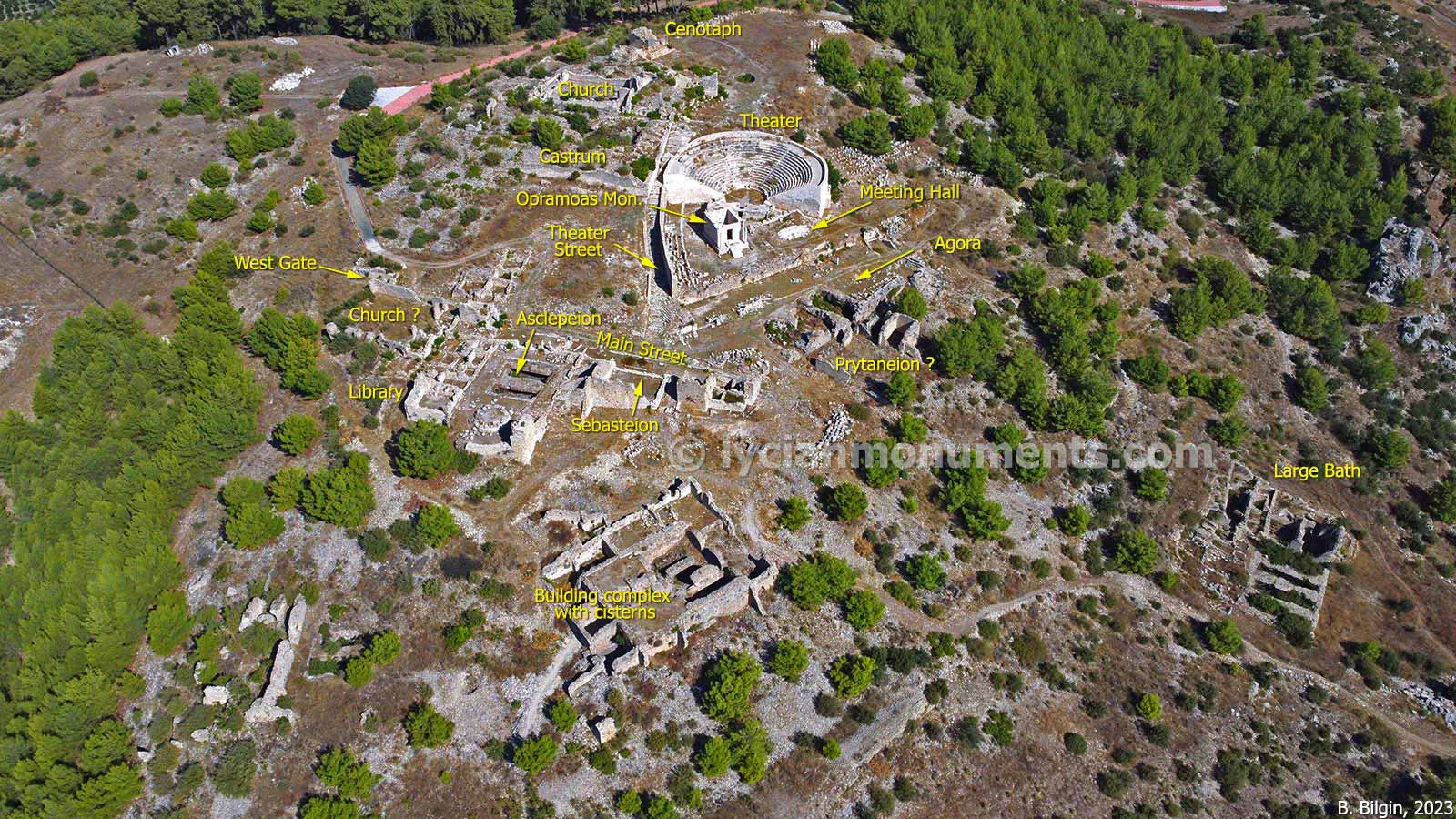


Theater of Rhodiapolis


Other structures


Opramoas Monument
Opramoas of Rhodiapolis was one of the most prominent figures of the Roman period in Lycia. He lived in the 2nd century CE, a time of prosperity for both Lycia and the Roman Empire as a whole. A member of one of the wealthiest families in Rhodiapolis, he also maintained close ties with other elite families across Lycia. Through agriculture, trade, and banking, he amassed extraordinary wealth for his time.
Opramoas held several important public offices, including that of Lyciarch (president of the Lycian League), high priest, and chief judge. However, his enduring fame rests primarily on his role as a benefactor (euergetes). Few cities in Lycia failed to benefit from his generosity. Following the devastating earthquake of 141 CE, which caused widespread destruction throughout the region, Opramoas donated hundreds of thousands of denarii for the reconstruction of Lycian cities. His total benefactions—to cities, the Lycian League, festivals, funerary and wedding expenses, and to the poor—amounted to several million denarii. He thus ranks among the most generous benefactors not only in Lycia but in the entire Roman world.
The Opramoas Monument is a temple-shaped mausoleum, most likely erected by his successors after his death. It is the only structure in Rhodiapolis constructed entirely of finely cut stone. Reflecting Opramoas’s status, it was prominently situated directly in front of the theater, at the center of the city.
The monument is especially significant for its inscriptions, which cover both lateral walls and the façade. It contains the second-longest known Greek inscription from the ancient world, after the Diogenes inscription at Oinoanda (also in Lycia). In total, 70 documents—including imperial letters, honorary decrees of the Lycian League, and correspondence from Roman governors to individual cities and the League—were engraved in chronological order with exceptional craftsmanship. The text is arranged in 20 columns, each comprising approximately 100 lines. This corpus constitutes an invaluable source for the social, political, and economic history of the period.
Restoration work on the theater and the monument was initiated in 2015 but was subsequently halted due to inadequate execution.


References:
Çevik, N., İ. Kızgut & S. Bulut. 2010. “Rhodiapolis, as a Unique Example of Lycian Urbanism,” Adalya XIII, 29–63.
Çevik, N. 2021. Lykia Kitabı: Arkeolojisi, Tarihi ve Kültürüyle Batı Antalya, Türk Tarih Kurumu, Ankara.
Kızgut, İ. 2016. “The City of Opramoas the Benefactor: Rhodiapolis,” in From Lukka to Lycia: The Land of Sarpedon and St. Nicholas, eds. H. İşkan & E. Dündar, 288–299, İstanbul.
Kokkinia, C. 2012. “Opramoas,” in The Encyclopedia of Ancient History, Vol. 9, 4907–4908.
Petersen, E. & F. Von Luschan. 1889. Reisen in Lykien Milyas und Kibyratis. Reisen im Südwestlischen Kleinasien II, Wien.
Spratt, T. A. B. & E. Forbes. 1847. Travels in Lycia, Milyas and Cibyratis, London.
Images:
Rhodiapolis Excavation Archive
kumluca.org.tr
T. A. B. Spratt & E. Forbes, 1847
E. Krickl, 1892
E. Petersen & F. Von Luschan, 1889
Rüdiger Gogräfe, 1982
Artichaeology
Gunthram, 2010
N. Çevik, 2021
Bora Bilgin, 2022, 2023
Ertuğrul Anıl, 2023
Tayfun Bilgin, 2023
Reha Özer, 2023